Food Cost Percentage for Restaurants in Oman: How to Calculate It
Food cost percentage shows how much of each rial of sales goes on ingredients. Here is how restaurants and cafés in Oman can calculate it, cost a recipe and set menu prices.
Contents
- Why this number matters in Oman
- The food cost percentage formula
- What is a good target?
- How to cost a single dish
- Six ways to bring food cost down
- Stop doing this in a spreadsheet
- Frequently asked questions
- How often should I calculate food cost?
- Should drinks be calculated separately?
- Does staff food count?
- Know your margin on every plate
Food cost percentage tells you how much of every rial of food sales you spend on ingredients. It is one of the first numbers to check when a busy restaurant in Oman is somehow not making money, because it shows whether the problem sits in your pricing, your portions or your stock control.
This guide shows how to calculate it, how to cost a single dish, and what to do when the number climbs. All figures in the examples are illustrative and use Omani rials (OMR).
Why this number matters in Oman
Margins can move quickly here. IMARC Group's Oman foodservice report lists high dependence on imported food, rising labor, energy and rent costs, and intense competition among the market's main restraints. If a supplier raises prices and your menu stays the same, your profit shrinks without any visible warning. Tracking food cost is how you catch that early.
The food cost percentage formula
You need three figures for one period, usually a month, plus your food sales for that same period:
- Cost of goods sold = beginning inventory + purchases − ending inventory
- Food cost percentage = (cost of goods sold ÷ food sales) × 100
Here is an example for a small café in Muscat:
- Beginning inventory: OMR 1,200
- Purchases during the month: OMR 3,400
- Ending inventory: OMR 1,000
- Cost of goods sold: 1,200 + 3,400 − 1,000 = OMR 3,600
- Food sales: OMR 11,000
- Food cost percentage: 3,600 ÷ 11,000 × 100 = 32.7%
Count ending inventory properly, on the same day each month. If you skip the stock count, the result is only a guess.
What is a good target?
There is no universal figure, and most published benchmarks come from the US market, so treat them as a starting point. Restroworks cites the National Restaurant Association for a typical range of 28% to 35%. Owner.com's benchmarks put quick service and fast casual at 25–30%, full-service at 28–32%, and bar or beverage-focused venues at 18–24%.
The most useful benchmark is your own trend. Calculate the number every month and investigate any sudden jump. A coffee-led café in Qurum will naturally run differently from a grill restaurant in Salalah.
How to cost a single dish
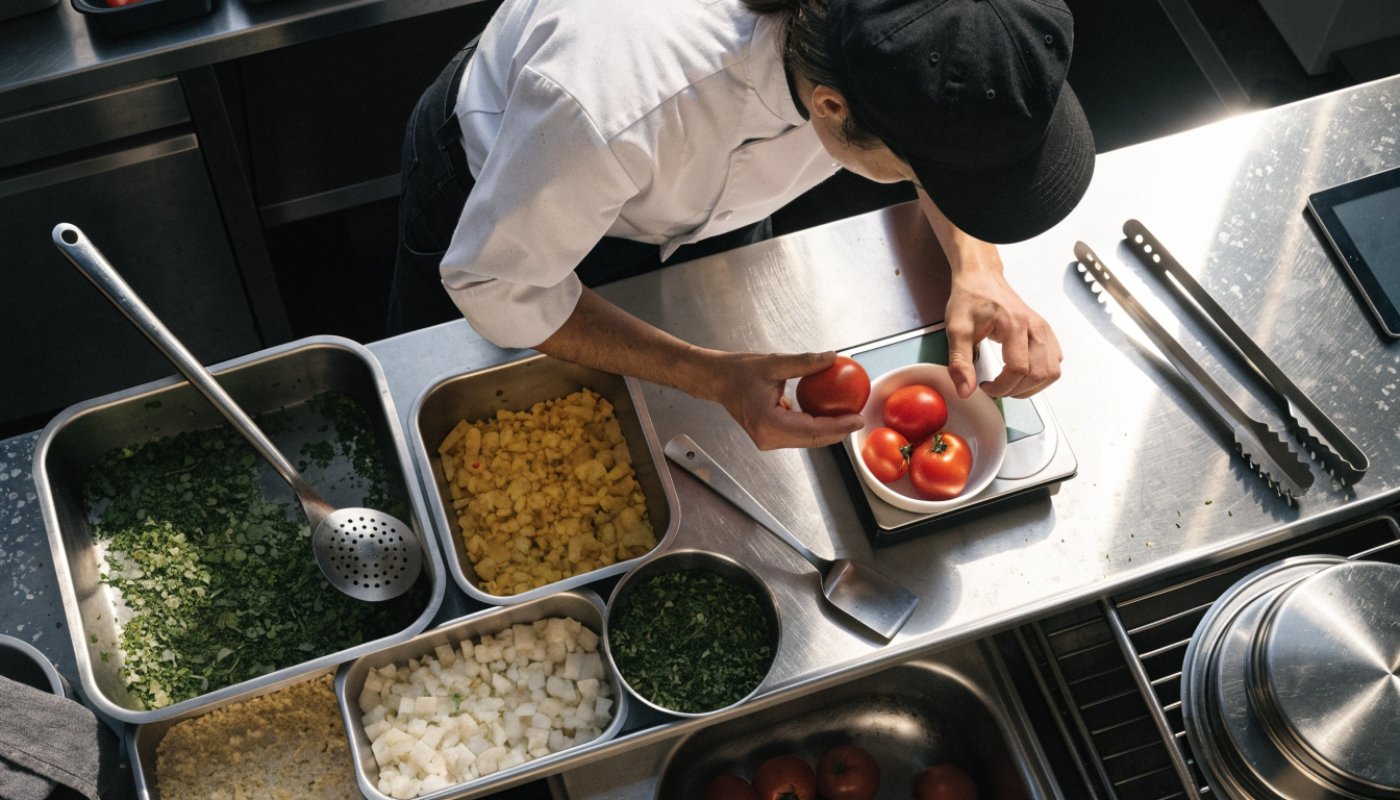
A monthly percentage tells you that something is wrong. Recipe costing tells you where. List every ingredient for one portion, weighed rather than estimated. For example, a chicken shawarma plate:
- Chicken: OMR 0.450
- Bread: OMR 0.060
- Garlic sauce: OMR 0.080
- Salad and pickles: OMR 0.120
- Fries: OMR 0.140
- Packaging: OMR 0.050
- Total plate cost: OMR 0.900
To find a price, divide the plate cost by your target percentage. At a 30% target, 0.900 ÷ 0.30 gives a price of OMR 3.000. Then compare that with the local market and what your guests will accept. Some dishes will carry a lower margin and others will make up for it.
Six ways to bring food cost down
- Standardize portions. Use scales and scoops, and write down the recipe.
- Compare suppliers regularly. Review the prices of your top ten ingredients every month.
- Use first in, first out. Rotate stock so older items are used before they spoil.
- Record waste. Log spoiled, dropped and returned food, and look for patterns.
- Engineer the menu. Promote high-margin dishes with better photos and positions.
- Update prices in time. Review pricing when a key ingredient rises.
The last two are much easier with a digital menu, because you can change a price or feature a dish without reprinting. Our guide to QR code menus for restaurants in Oman explains how to set one up.
Stop doing this in a spreadsheet
Spreadsheets work until prices change or the team gets busy. A connected system does the math as you trade. In SALAM MENU, Pro plans let you attach a recipe to each dish, deduct ingredients from stock automatically as orders come in, and see the food cost ratio and a suggested price. Sales, expenses and net profit are reported per branch, with Excel export.
Frequently asked questions
How often should I calculate food cost?
Monthly at a minimum. Weekly is better for venues with high volume or fast-changing supplier prices.
Should drinks be calculated separately?
Yes, where you can. Beverages usually carry a lower cost ratio, and combining them can hide a problem with food.
Does staff food count?
Record it separately. Otherwise it will inflate your food cost without showing up in sales.
Know your margin on every plate
You can test all of this with your own menu. Start the 30-day free trial, then compare plans and pricing in Omani rials to see which one fits your restaurant.
Build your restaurant’s digital menu today
Try it free for 30 days — no card required.